
Beyond Architecture: Shaping the Future of Singapore’s Built Environment Through Education and Industry Leadership

At Archtur Pte Ltd, we have always believed that architecture extends far beyond the creation of physical spaces.
While buildings may stand as visible outcomes of our work, the true responsibility of an architect lies in shaping experiences, guiding stakeholders, solving complex problems, and contributing meaningfully to the broader built environment ecosystem.
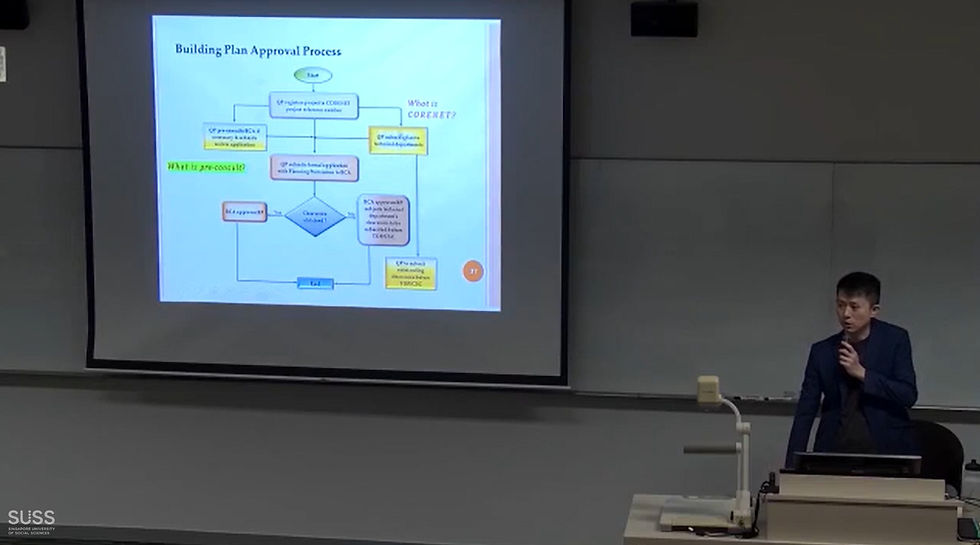
This belief recently led Ar Jonathan Lim to contribute as a lecturer for the Building & Project Management programme at the Singapore University of Social Sciences (SUSS) 2 years back, where he shared practical industry perspectives with aspiring built environment practitioners and future project leaders.
Course reference: SUSS BPM203 – Construction Project Management
Bridging Academia and Real-World Practice

The transition between academic theory and real-world industry practice is often one of the greatest challenges faced by young professionals entering the built environment sector.
While technical knowledge forms an essential foundation, the realities of practice demand far more:
Navigating regulatory frameworks
Managing multidisciplinary coordination
Understanding project risks
Leading stakeholder communication
Balancing design intent with commercial realities
Responding to evolving authority requirements
Managing timelines, budgets, and construction complexities
During the session, Jonathan shared practical insights drawn from years of professional experience within Singapore’s architectural and construction landscape, helping students better understand the responsibilities and pressures faced by architects and project teams in actual project environments.
Topics discussed included:
The Building Plan approval process in Singapore
Regulatory coordination with authorities
Roles and responsibilities of consultants and participants in the project and/ or industry ecosystem
Contract administration and project management realities
The importance of leadership and accountability in the built environment
Evolving expectations placed on architects today
More importantly, the session sought to provide students with clarity on how architecture interacts with the wider ecosystem of developers, engineers, contractors, quantity surveyors, interior designers, authorities, and project managers.
The Architect’s Role Is Evolving
In today’s increasingly complex built environment landscape, the role of the architect can no longer be narrowly defined by design alone.
Architects are increasingly expected to:
Think strategically
Coordinate multidisciplinary teams
Understand development and business objectives
Navigate regulations and compliance
Anticipate project risks
Facilitate communication between stakeholders
Balance user experience, sustainability, and commercial viability
At Archtur, we view architecture as an interdisciplinary practice that combines design thinking, systems thinking, and human-centered problem solving.
This broader perspective enables us to support not only homeowners, but also developers, investors, businesses, and families seeking long-term value creation through the built environment.
Paying It Forward to the Industry
As a boutique architectural practice in Singapore, we believe meaningful industry contribution should not stop at project completion.
Contributing to education, mentorship, and industry dialogue is equally important in helping shape a stronger and more future-ready built environment sector.
The opportunity to engage with students and future practitioners reflects Archtur’s continued commitment to:
Knowledge sharing
Professional mentorship
Industry collaboration
Public awareness of architecture and the built environment
Raising standards of practice and professionalism
We believe that by openly sharing experiences, lessons, and industry realities, we can help younger professionals enter the industry with greater preparedness, awareness, and confidence.
In many ways, the future quality of our cities and communities depends not only on the buildings we create today, but on the practitioners we nurture tomorrow.
Architecture Beyond Buildings
At its core, architecture is ultimately about people. It is about understanding how individuals live, work, heal, gather, grow, and connect within spaces.
It is about creating environments that support businesses, strengthen families, shape communities, and influence future generations.
This is why our work at Archtur extends beyond architecture as a service. We aspire to contribute meaningfully to conversations surrounding:
The future of homes
Intergenerational living
Sustainable development
User experience in spatial design
Business and lifestyle transformation through space
Long-term property and development strategies
Education and mentorship therefore become natural extensions of our practice philosophy.
Looking Ahead
As Singapore’s built environment continues to evolve amidst changing economic, social, and environmental realities, the importance of collaboration, leadership, and continuous learning will only become more critical.
Archtur remains committed to contributing thoughtfully to the industry — not only through the spaces we design, but also through the knowledge we share, the people we mentor, and the conversations we help shape.
Because ultimately, architecture is not simply about constructing buildings. It is about building clarity, trust, experiences, communities, and legacies that endure far beyond the completion of a project.
About Archtur Pte Ltd
Archtur Pte Ltd is a Singapore-based architectural and spatial design practice specialising in landed residential, boutique commercial, hospitality, and user-centric built environment solutions.
Our approach integrates architecture, branding, user experience, and strategic thinking to create spaces that are not only visually compelling, but meaningful, functional, and commercially sustainable for the people who use them.
For collaborations, speaking engagements, partnerships, or project enquiries, please contact us through our official website.


Comments